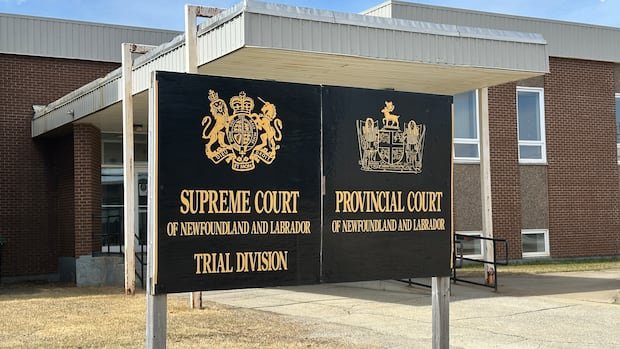
Language issues continue to dog the court appearances of a Quebecer accused of first-degree murder in Happy Valley-Goose Bay, N.L., who elected for his case to be heard in French.
While a previous hearing made headlines when a Crown prosecutor said he didn’t feel comfortable speaking “legal French” before a judge, Dave Faucher’s latest provincial court appearance on Oct. 27 featured an interpreter who was unable to translate the word “divulgation” into English.
“Divulgation” is the French word for “disclosure.” Given the nearly 15-minute hearing focused almost entirely on evidence disclosure timelines, the Crown eventually felt it necessary to correct the interpreter, who was participating remotely.
“‘Disclosure’, the word is ‘disclosure,’” said prosecutor Mary Bellefleur, a francophone Crown appointed to the case last month.
Meanwhile, Judge Wynne Anne Trahey complained during the same hearing that it was difficult to understand the interpreter, who participated by distance and whose voice boomed from a loud speaker in the Wabush courtroom.
“The sound is not good,” said the judge, adding at one point that the clerk “didn’t understand anything” the interpreter was saying.
English interpretation appears to have been offered given the clerk and the family of Franz Drosch, the man Faucher is accused of killing in 2023, didn’t speak French.
No certification process for interpreters
The interpreter for the Oct. 27 court appearance was provided by the Association for New Canadians, whose spokesperson David Slavick wouldn’t speak to individual workers’ qualifications but confirmed “there is no formal certification process for interpreters in Newfoundland and Labrador.”
Joanne Turner, the CEO of the provincial and Supreme courts, said “there is no one consistent certification training or process due to the hundreds of languages and dialects necessary.
Long-time interpreter Jeff Staflund said that’s not quite the case.
“Standards exist, but they’re not upheld,” said Staflund, who helped establish a legal interpreter training program at Université Sainte-Anne in Nova Scotia. “Interpretation isn’t a regulated profession either, so there’s no legal requirement to verify whether someone has passed the national certification exam.”

Jeff Staflund is a long-time translator and court interpreter based in Winnipeg. (Jeff Staflund)
“It’s the agencies who hire us and the organizations that require our services that need to make sure standards are met,” added Sheila Hussain, the president of the Ontario Court Interpreters’ Association.
For interpretation in the country’s two official languages, there is a healthy pool of interpreters in provinces such as Manitoba and New Brunswick, according to Staflund. He said New Brunswick has a uniform training and exam process, but described interpretation services in most of the country’s courts as the “wild west.”
“People don’t understand the difficulty of the work. They think that anyone who is bilingual can perform this task, when it takes quite intensive training and skills that go beyond the simple ability to speak two languages,” said the former head interpreter for New Brunswick, now based in Winnipeg.
Justice minister ‘unable to comment’
In the Faucher appearances to date, consecutive interpretation has been offered. When consecutive interpretation is used, the speaker — whether the judge, a lawyer or a witness — expresses one thought at a time, then waits while the interpreter steps in to translate.
While consecutive interpretation can sometimes prove painfully slow, it is the translation method most commonly used in Canadian courts, according to Staflund.
Asked whether she had concerns about the quality of interpretation in the Faucher case, and in the province’s court system more generally, Justice and Public Safety Minister Helen Conway Ottenheimer declined to comment.

Helen Conway Ottenheimer is the province’s justice and public safety minister. (Ryan Cooke/CBC)
“The questions posed relate to ongoing court proceedings; therefore, in my role as minister of Justice and Public Safety and Attorney General, I am unable to comment,” reads a statement from Conway Ottenheimer provided by spokesperson Vaughn Hammond.
“Concerning the interpretation services provided by the provincial court, these are operational matters and, as such, any questions should be directed to the provincial court.”
Turner said the courts she oversees hire their interpreters through the ANC but also the province’s Francophone federation and several Indigenous band councils. When local interpreters aren’t available, they work with “a number of companies” elsewhere in the country to find the staff they need.
Quality interpretation essential, says expert
Staflund said he recognized that ensuring consistent, high-quality court interpretation isn’t an easy task.
He said training programs are too few and often too expensive. He also said interpreters often aren’t paid enough and that the relatively low demand for interpretation services in provinces such as Newfoundland and Labrador makes it difficult to gain experience and maintain stable hours.
However, Staflund said reliable, accurate court interpreters are essential to a functioning court system.
“The accused and the witnesses need to be understood and need to understand,” he said.
Faucher’s next court appearance is Friday.
Trahey is hearing the case because there is no available bilingual judge in Happy Valley-Goose Bay.
Download our free CBC News app to sign up for push alerts for CBC Newfoundland and Labrador. Sign up for our daily headlines newsletter here. Click here to visit our landing page.
Leave a Reply